Contact me Go to home page Return to main travel page
Return to Provence
2026
*
Michael Kluckner
Contact me Go to home page Return to main travel page
Artwork & text © Michael Kluckner, 2026
| The first time in Provence for us since
1993, when we spent three winter months moving slowly along the Mediterranean
coast from Catalonia all the way to Sicily. And there was an
earlier trip, in the fall of 1986 – the first time I took a
sketchbook and really tried to record my impressions. The rambling
essay at the bottom of the main travel page
describes all the style changes I've made since early
ambitious-robust-carrying-lots-of-paints-and-big-sheets-of-paper,
to smaller sketchbooks, to my recent minimalist, 13 x 21 cm.
Moleskin-and-pencil efforts. To be honest, the early stuff was
better, or at least more finished and colourful, than what I'm
doing now, but I keep telling myself I'm 75. Some of the bits
below are pretty rough: I've left them as they were when we left
France, rather than refining them after the trip was over. We landed in Paris in late January and were on the TGV fast train to Montpellier later the same morning. As explained below, the hotel there was the only booking we had. We "wing it" when we travel, as per my book to be released this spring. It was a wet winter, much wetter than our long trip years before – the weather was a subject of many conversations we had with the friendly people in this part of France. Montpellier is a small, pretty city with an illustrious academic history, especially its medical school dating back more than 1,000 years, and one of the oldest botanical gardens in France. We stayed there in December 1992 at the Hotel du Palais and on a chilly sunny morning I did a quick sketch out of the chambre's window. The same family owns it as did in the early '90s. We took them a print of the sketch which pleased them. The young woman who was at the desk when we arrived said she wasn't yet born in 1992. |
The 1992 sketch (I annotated the print I gave to them with the name of the hotel).

We got a room this time on the same floor. The weather had been cool and showery.

This is the hotel; it's a short walk through beautiful narrow streets to the centre-ville.

In the sketch below, Cookie is the hotel's cat.
She became very annoyed if any hotel guest sat in that chair near the window, even at breakfast.

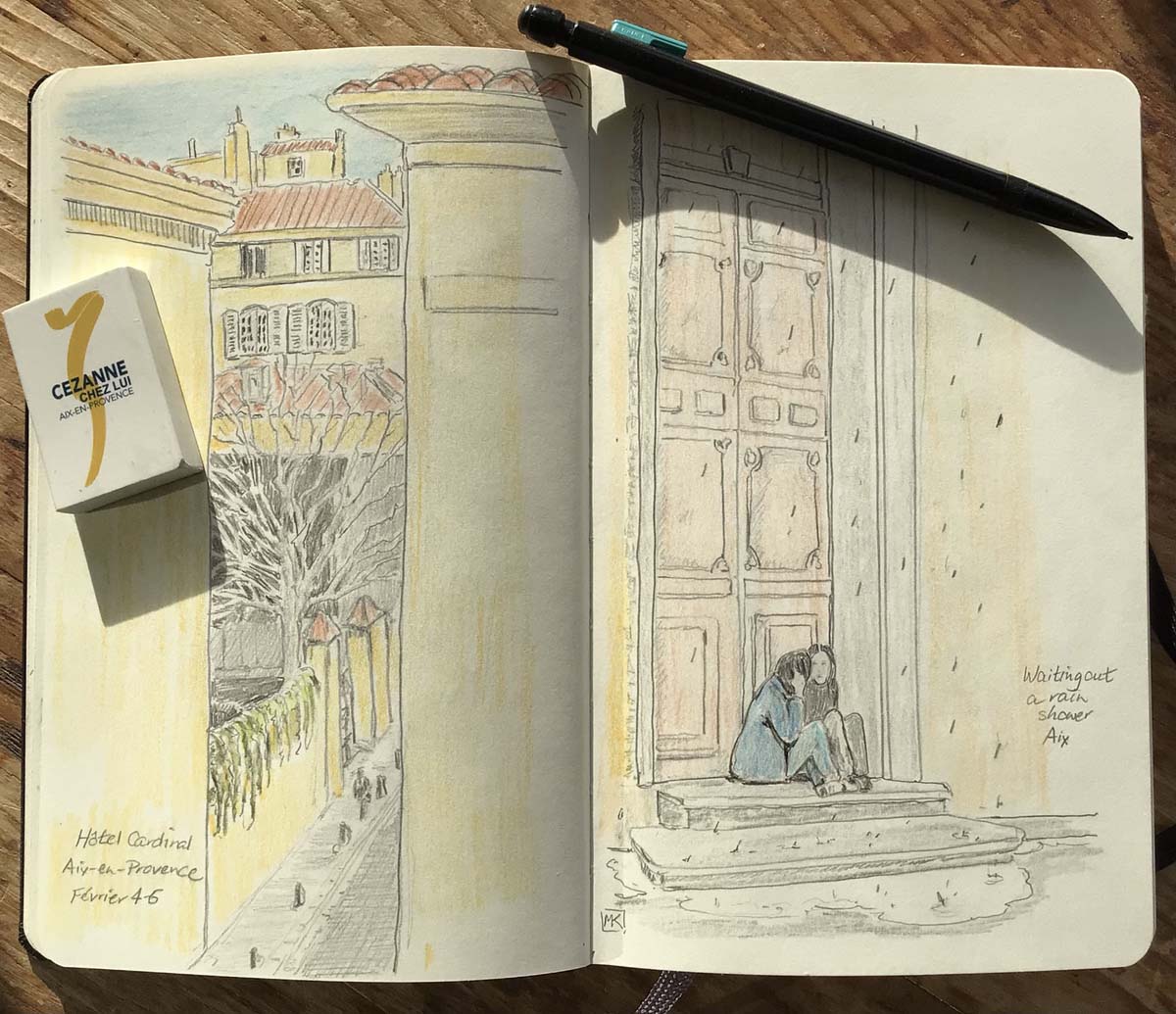
After a few days in Montpellier, we caught the train to Aix-en-Provence. Some sun, some rain showers.
We stayed at the Hôtel Cardinal where we'd stayed on our 3-month journey in 1992.
On the left: the view from our window on a sunny morning.

| Aix-en-Provence has two excellent art museums, the Musée Granet
which lives off its connection with Paul Cézanne (as Arles is
infused with the memory of Van Gogh), who lived and painted in the
area for many years. There is also the excellent Caumont Centre
D'Art, which had a great exhibit of the collection of Oscar Ghez
(1905-1998) in its 18th century building. |
 |
... and, below, the Caumont also has a geometrically challenging garden which distracted me for a few minutes.
Below on the right: a pigeon with a classy vantage point in Sanary-sur-Mer.

| Sanary-sur-Mer on the coast near Toulon is the prettiest harbour
we visited. It was a sunny morning following a terrific rainstorm
the previous afternoon – our first day with a rental car. We
wanted to be able to roam the area as we had done many years
earlier, but found it challenging as the population has increased
hugely, the roads are congested, and the cars/SUVs on the narrow
village streets are much bigger than they were once. Parking our
newly rented car was a problem, so we moved on without staying
another night in the so-so hotel we'd found on the spur of the
moment. (We kept the car just 4 days.) Below: my slightly churlish sketchbook page from 1993. |

Below in 2026: quite a surf following the previous day's storm.

Lots of coffee drinkers along the esplanade at 10 in the morning...

...and the pretty boats.

| We thought when we rented the car that we would stay in
Hyères-les-Palmiers and use it as a hub for daytime roadtrips, but
it had grown a lot over the decades and wasn't as appealing as we
remembered. We garaged the car for the afternoon and hiked around,
mainly to see the fine gardens on the steep hill at the northern
edge of the town centre, then moved on. |

| The sketch on the left above has a mimosa – the yellow tree. It
is a type of Australian wattle that has turned into a (very
pretty) weed all over the Côte d'Azur coastline. It gives
wonderful colour in the winter sunlight. Below is a 1993 watercolour (about 30 x 50 cm or 12 x 18 inches, the size of paper I was carrying that time) of the Parc St. Bernard in Hyères. The building in the middle distance is barely visible now, as the low plants and small trees have grown so much. And there were a lot more flowers in bloom in January '93 than in February 2026. |

| Our next hub for a few days was Bormes-les-Mimosas, a hillside
village above the Mediterranean a little distance east along the
coast from Hyères. The weather continued to be very changeable. We
had a small, spare apartment near the park (the image below) that
looks down the slope toward Le Lavandou, a beach resort that has
grown considerably over the past 30 years. Bormes was still
charming but most of its commerce, other than a few restaurants
and bars, had moved farther down the hill close to the main
east-west highway. |

| Above: one entertaining element of a drive through the country
was seeing the flocks of sheep spending the winter in the lowlands
grooming the vineyards; in the spring they would be led up to the
higher fields in the legendary "transhumance." A reason to return to little Bormes-les-Mimosas was to see whether the hotel where we'd stayed, and where I painted the picture below of Christine on the balcony on a warm January day, still existed. It used to be called the Provençal and is now Le Bellevue – much renovated and improved since we stayed there. We showed the proprietor the watercolour and he said right away "Chambre 10" and took us to see it. |


| On another day, we drove out along the coast to La Croix Valmer,
where we'd rented a gîte (cottage) for a week in '93. So much had
changed – new resort hotels and condos, wider roads with groomed
edges – but we eventually found the little place, which is still
rented by Gîtes de France. |


Along the way, the Hôtel L'Orangerie was closed for the winter...

I'd put it into the sketchbook in '93.

| We returned the car to Aix and took trains from there to Arles,
where we'd decided to spend the final few days. Luck had it that
we were able to rent an apartment called La Vue du Rhone, which
was very comfortable and had a lovely view out onto the (you
guessed it!) Rhone River. I didn't spend a lot of time on this little croquis. |

Below: from our apartment window, morning sun...


The view from across the river: the black doorway under the little arch was our apartment building's entry.
We wandered a lot, taking little time for serious drawing and not finishing anything...

| The attraction of Arles is the layers and layers of history: a
Roman arena, buildings from every century since that era, and the
overlay of Vincent Van Gogh's time there in the 1880s. It has
superb museums and galleries, as well as a vibrant scene of cafés
and bars. Below: a 1686 drawing by F. Beytret (?) showing the arena as it was until 1822 when the French government ordered the clearing of all the dwellings (more than 200 of them) and shops that had taken root there over the centuries so they could commence the restoration of the arena. In a way it's a pity to have it cleared and looking quite forlorn, except probably for festival days. |

Below: a watercolour sketch from 1992.
We spent a few days there at the New Year, la fête de Saint Sylvestre.

The cloister at St. Trôphime, with its attached tower, is another highlight.

In 1986, we stayed at a nearby hotel, La Cloître, where I painted the view out the window.

And the hotel where we stayed is still there, but closed for the winter.

| Arles is the centre for the study of Vincent Van Gogh, who lived
there from February 1888 to May 1890, before moving north and
dying by suicide: there is the Fondation Vincent Van Gogh
Arles, a museum that has exhibitions of works inspired by
Van Gogh's example (with some rather theoretical art-speak, in our
opinion), and this statue of him in the Jardin d'Été park by
American artist William Earl Singer. Most of Van Gogh's originals
are in museums in Paris and Amsterdam. |
 |
 The statue shows the lobe of the left ear removed, while Van Gogh's self-portrait shows it as the right ear, which makes sense as he was copying his mirror image, presumably. How much of the ear did he cut off? According to art historian Bernadette Murphy, it was the entire ear. A 2019 blog post by Virgie Hoban on the UC Berkeley Library site describes the sleuthing. Below, a panel from the small art museum in Bormes-les-Mimosas about pendre en plein-air, the style of painting outdoors practised by Cezanne, Monet, Van Gogh and others that kicked the door open to Modern Art in the late 19th century. |

| And, a few passengers on the train back to Paris... There's a
trick to drawing people who are looking at their phones but are
easily distracted by movement, such as the head of a sketcher
bobbing up and down. I did NOT want to be spotted by them
intruding on their privacy. It's not as bad as taking someone's
photo without permission, but still... This was an exercise in
holding my head still, looking down at the sketchbook, and only
moving my eyes up and down. And then putting the sketchbook away
till next time. |

Contact me Go to home page Return to main travel page